
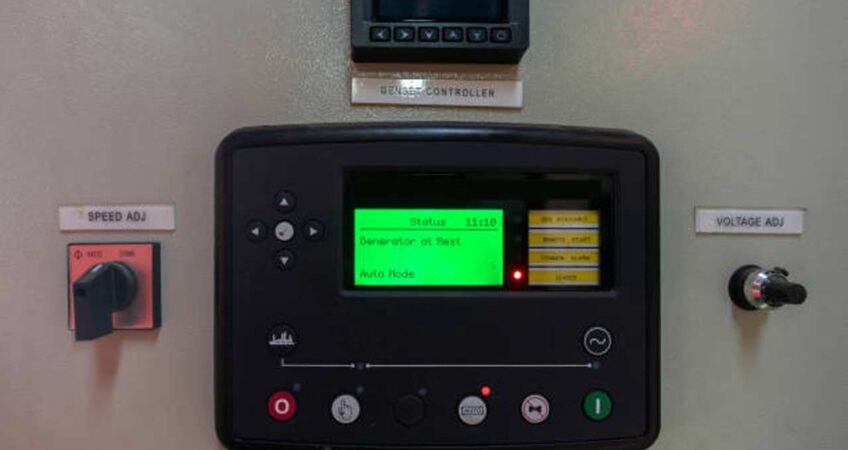
While a legacy manual generator panel provides little or no insight into the status of operations until the panel has been physically visited, a ComAp smart control panel is able to provide early awareness that a parameter has drifted outside of acceptable limits and, in many cases, allow for remote checking of the generator itself before visiting the unit.
The upgrade in functionality is nearly universal, but the most common concern for plant managers considering this type of retrofit is whether or not retrofitting existing generators is a better course of action than waiting to replace the entire generator with a new one, and what the retrofit process entails.
This guide will discuss the differences between traditional, basic electromechanical generator panels and ComAp smart control systems, examine the real-world retrofit process, and review the automatic transfer switch and remote monitoring capabilities that come standard with these Comap smart control systems, to illustrate why the upgrade is typically recommended and worth pursuing for most facilities.
What “Traditional” Generator Control Actually Means Today
Traditional generator panels vary widely in complexity, but all have been designed to prioritize on-site, manual inspection and operation rather than remote monitoring or data collection.
Manual inspection means that the generator can only be confirmed as operating normally or have its fault diagnosed when an operator views the panel’s indications. Basic automatic start capability is often the extent of “smart” functionality for a traditional panel, without the ability to log detailed fault history for later analysis of a recurring problem.
While this approach was appropriate for the equipment and facilities that utilized these types of panels in the past, the increased demands of modern facilities have created new challenges, and the limitations of these legacy panels can begin to feel like deficiencies.
What ComAp Smart Control Adds
The ComAp smart control line of controllers (InteliLite for single generator standby, prime, and peak shaving applications, InteliATS and InteliATS2 for automatic transfer switching, and InteliGen for paralleling applications) offer a complete replacement for traditional generator panels: fully automated fault logging and alarm history recording, remote monitoring enabled by default through web access, and in the cases of their ATS variants, the same automated switching functionality that previously had to be managed by a dedicated automatic transfer switch.
ComAp’s remote monitoring capabilities also extend to generator-specific remote diagnostics and maintenance recommendations, when paired with their AirGate remote connectivity technology.
This means that an operator can typically check the status of a generator remotely, without having to travel to the site or configure a secure connection through an IP address, in order to view alarms or fault history that were recorded by the controller.
With ComAp controllers, the limitations of a traditional panel can be replaced with remote access to the generator’s alarm and event history, which can be instrumental in diagnosing intermittent faults that may not be reproduced at the time of inspection.
Automatic transfer switching, normally the responsibility of a separate automatic transfer switch, can also be fully automated and monitored through the ComAp controller, in the case of an InteliATS or InteliATS2 retrofit.
Comparing Traditional Panels and ComAp Smart Control
Traditional generator panels and modern ComAp control systems differ in monitoring, diagnostics, automation, and configuration flexibility. The comparison below highlights their key operational capabilities.
| Capability | Traditional / Legacy Panel | ComAp Smart Control |
|---|---|---|
| Fault Visibility | Often requires on-site inspection | Automated fault logging and alarm history |
| Remote Monitoring | None or limited remote access | Remote monitoring through WebSupervisor and AirGate |
| Transfer Switching | Manual or basic automatic switching | Automated ATS with monitoring through InteliATS / InteliATS2 |
| Diagnostic History | Limited or no event records | Detailed, time-stamped event logging |
| Configuration Flexibility | Generally fixed during installation | Software-based configuration using LiteEdit or InteliConfig |
| Multi-Unit Coordination | Often limited or unsupported | Supported through paralleling controllers such as InteliGen |
Retrofitting vs. Full Replacement: What Plant Managers Should Weigh
This is frequently the primary consideration for plant managers who understand the advantages of smart control panels, but are unsure how to proceed with an upgrade.
Full generator replacement is typically an expensive endeavor, and not one that is typically pursued just to gain access to the latest in control panel technology, especially when the upgraded control panel is a significant portion of the replacement cost.
ComAp smart control retrofit panels are explicitly designed to address this concern: the RC-3 retrofit control panel, built around the InteliGen 200 controller, is intended as a cost-effective alternative to full generator replacement for facilities looking to replace an aging or deficient control panel for one of their existing generators. This retrofit approach is appropriate for both existing generators that have reached the end of their useful life and generators that are still mechanically sound but utilize a control panel that has fallen significantly behind the state of the art.
The specific considerations for each retrofit approach are discussed later in this guide.
The RC-3 retrofit panel is built around the InteliGen 200 controller and offers remote monitoring and fault logging capabilities, along with the ability to support multi-unit paralleling applications where required, as appropriate for the type of generator being retrofitted.
Retrofit panels like the RC-3 are often used as a solution for facilities with a mixed fleet of generators, some of which are still operating reliably and would be cost-effective to retrofit while others may have exceeded their expected service life and should be replaced as soon as possible.
ComAp smart control retrofit panels also offer broad compatibility with modern emissions-compliant engine platforms, including those utilizing an electronic control unit, in retrofit applications.
What a Realistic Retrofit Process Involves
The retrofit process for existing generators is typically well understood ahead of time, but it’s worth reviewing the major considerations to set realistic expectations for the upgrade.
Assessment of the existing generator and engine compatibility. Before retrofitting an existing generator, a facility will need to identify the compatibility of the engine with the ComAp retrofit panel they’re planning to install, including whether the engine utilizes an electronic control unit, and what communication protocol the ECU utilizes, if one is present.
Selection of the appropriate controller tier. The appropriate retrofit panel is typically specified based on the application of the generator being retrofitted: a single-generator standby application would typically call for an InteliLite retrofit panel, but a facility with multiple generators that need to share load and operate in parallel would instead specify an InteliGen-based retrofit panel.
Physical installation and wiring integration. Retrofit panels typically involve relatively simple physical installation, but the wiring integration with the existing sensors and starting system on the retrofit generator, and any existing transfer switch infrastructure for generators utilizing such a switch, require careful planning.
Configuration and commissioning. ComAp controllers are typically configured using software tools like LiteEdit or InteliConfig, and the property commissioning process typically includes validating alarm thresholds, transfer switch logic, and remote connectivity prior to considering the retrofit panel fully commissioned.
Establishing remote monitoring access. Setting up the WebSupervisor or other remote access as part of the commissioning process will ensure that the site is able to derive maximum value from the retrofit panel right away, rather than making remote monitoring a secondary task to configure separately at a later date.
Why Remote Monitoring and Fault Logging Matter Beyond Convenience
While the value of remote genset monitoring may seem like a convenient luxury for plant managers who want to minimize travel, it’s a much more valuable tool for addressing developing issues before they become disruptive to operations.
Faster response to developing issues. With automated alarms that can be viewed remotely, developing issues can be addressed and resolved days or weeks in advance of an outage, rather than waiting for the next scheduled site visit or an unexpected failure of a generator to occur.
Better diagnostic data. The ability to capture detailed fault records and event logging from a ComAp smart control panel can be a valuable tool in diagnosing intermittent issues, which are typically much more challenging to diagnose without a dedicated remote monitoring system that is capturing conditions in real time.
Fewer unnecessary site visits. For facilities that are monitoring the status of multiple generators at a number of different locations, the ability to check the status of a generator remotely can reduce unnecessary and time-wasting site visits to generators that are operating normally.
More robust documentation for compliance and reporting. Automated fault logging and event logging in a ComAp smart control panel are often considerably more compelling evidence than handwritten notes or verbal testimony from operators for proving that a procedure was completed or an issue was identified before a potential outage, which can be crucial for facilities with regulatory oversight or contractual uptime requirements.
Making the Business Case for the Upgrade
For plant managers who need to build a business case for the upgrade internally, framing the retrofit around reducing risk, not just convenience, is likely to resonate most strongly with management. A legacy panel’s limitations may not seem like much of a concern until the manager has to respond to a site emergency and realize that the manual transfer switch is more likely to fail them in a moment of crisis.
The retrofit of an existing, mechanically sound generator with a ComAp smart control panel reduces risk at a much lower cost than waiting for a full generator replacement cycle, while also reducing maintenance and diagnostic costs with the ability to remotely check the generator status and diagnose intermittent faults.
Sourcing ComAp Retrofit Solutions
Jawaid Enterprises carries ComAp smart control components for facilities looking to retrofit their existing legacy generator control systems. Whether you’re retrofitting a standalone standby generator or seeking to upgrade the control system for automatic transfer switches across multiple generators, ensuring that you select an appropriate controller tier is the first step in identifying potential retrofit options.
Frequently asked questions
Can I retrofit ComAp smart control onto an older generator without replacing the whole unit?
In many cases, yes. ComAp offers retrofit-specific solutions like the RC-3 control panel, built around the InteliGen 200 controller, to upgrade the capabilities of legacy generator panels without requiring full unit replacement, provided the generator’s engine and electrical systems remain compatible.
What’s the difference between InteliLite and InteliGen for a retrofit project?
InteliLite is designed for single-generator standby and prime power applications, while InteliGen is built for paralleling applications, so the right choice will depend on whether you’re retrofitting a single generator or need to retrofit multiple generators that need to share load and synchronize.
Does upgrading to ComAp smart control require a new automatic transfer switch too?
Not necessarily as a separate purchase – ComAp’s InteliATS and InteliATS2 controllers are specifically designed to manage automatic transfer switching, so an ATS upgrade can be planned alongside or as part of a retrofit for the control system.
How does remote monitoring actually work with older generator installations?
ComAp’s WebSupervisor platform, combined with their AirGate remote connectivity technology, provides cloud-based monitoring that doesn’t require complex network configuration at the site, which makes remote access practical even for facilities without dedicated IT infrastructure for industrial equipment.
Is a full control panel retrofit worth it for a generator that’s several years old?
Often yes – provided the generator’s mechanical and electrical systems remain in good condition, the retrofit cost is typically far lower than full generator replacement, and the operational benefits of remote monitoring, fault logging, and automated transfer switching apply regardless of the generator’s age, as long as the underlying equipment is sound.